
Product and quality
What is the Story of House of Pasta?
House of Pasta has its origins in Veneto. It's a genuine Italian pedigree, not a generic idea of old world Italy, this is pasta made the way it was always meant to be made, by people who still make it that way.
Can you really call this handmade?
Yes, and that's rare in this category. Every piece is filled by hand, so pieces vary by 2 to 3g and no two look quite the same, pinched by hand rather than stamped. A lot of pasta labelled "handmade" elsewhere is actually filled by machine and only closed by hand, which is why it comes out identical every time. This is the real thing, so you can put it on your menu with confidence.
Is it precooked?
No, it's raw. Many frozen competitors preboil their pasta, and it can be around 30% water by weight, so you're partly paying for water. With this, every gram on the plate is pasta.
Does hand filling actually change the texture?
Yes, and you'll notice it. Because nothing is injected by machine, you get the bite chefs actually want, without the trade offs a filling machine forces on size, speed and how wet the filling ends up.
How it's made
How is it actually made?
The traditional way. A roller presses the pasta sheets, the only machine involved, then the team fills every piece by hand at a wooden table. For prawn ravioli, someone places the prawn into each piece individually, which is why no two are ever quite the same.
What checks does it go through before it reaches you?
Every tray is pasteurised, then blast frozen, then passed through a metal detector before it's boxed. That gives it a longer shelf life too, and stops pieces sticking together once frozen, so what you open is exactly what you expect.
What flour goes into this pasta?
A quality semolina, chosen to give a good bite without being overly firm or hard to eat, the kind of texture that works across a menu, from a casual plate in a café to a more considered dish in a restaurant.
Packaging and using it
What comes in a box?
Two 1.5kg trays, giving you 3kg per box, sized to sit easily on a standard fridge or freezer shelf.
Why trays instead of bags?
They cost more to produce, but they’re far easier to work with. A tray keeps every piece separate so nothing sticks together or gets crushed, and it stacks more neatly than a bag, which tends to slump and take up space. You can go straight from freezer to pan with next to zero wastage.
How many portions does a tray give me?
Roughly eight if you’re plating for a restaurant, or six for a pub, depending on how generous your portions are.
How long does it keep in the freezer?
Up to 12 months, so you can keep stock on hand.
How long does it keep once defrosted?
We recommend using it within 3 to 4 days. Keep it covered in the fridge and cook to order as you need it.
Can I refreeze it once defrosted?
We don’t recommend it, but you won’t need to. Because the pieces don’t stick together, you can take out only what you need and keep the rest frozen.
How long does it take to cook?
Cook it straight from frozen in boiling salted water for 3 to 4 minutes. Our larger shapes take a little longer. Check the product page for the exact cooking time for each shape.
What about allergens?
Full allergen information is on each product page. Just click on the pasta you’re interested in.
Do you have vegetarian options?
Yes. You can filter the range on our website by category, including vegetarian, so you can quickly find what suits your menu.
How much does it cost per portion?
Each product page shows portion advice and an approximate price per portion, so you can work out your food cost before you order.
What if I have another question?
Message us on WhatsApp or email ciao@salvo1968.co.uk and we’ll be happy to help.
Do I need a skilled pasta chef to use it?
No. Defrost it in the morning, portion it into a dish, cover and refrigerate, then it's ready to cook to order. Anyone on your team can take it from defrost to plate, so you're not relying on one specialist during service, and it works just as well for a hotel kitchen running overnight with minimal staff as it does for a full brigade.
Range
What shapes do you offer and what size do they come in?
We offer various shapes. Please find below our Pasta Index, to give you a better idea of what House of Pasta has to offer: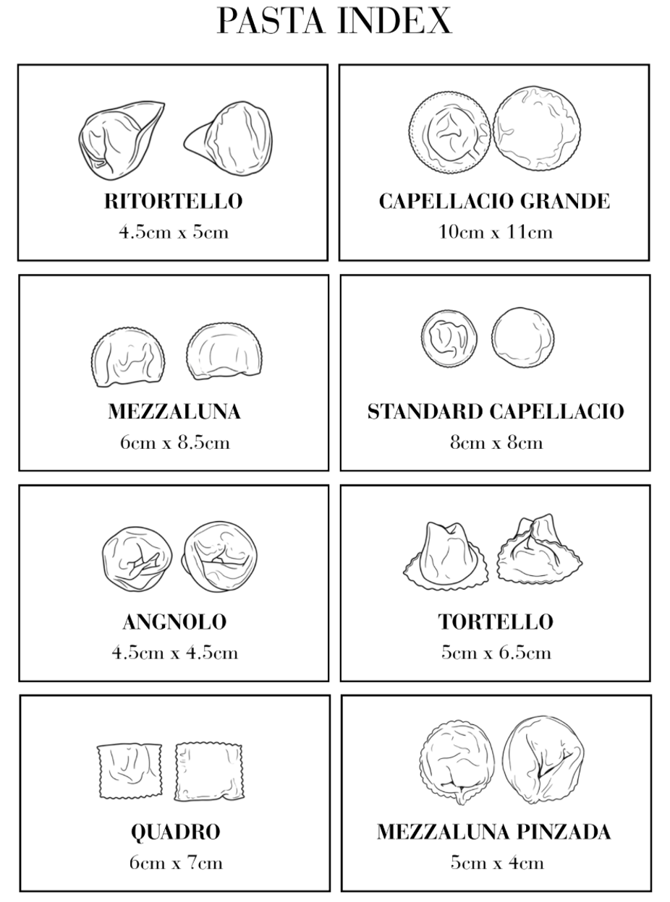
Do you do lasagne in the same format?
Yes, cut into squares. It's a competitive category in the UK, so the way to stand out is on quality rather than price, and that's exactly what this gives you.
Any examples of how others have used it?
One recent example was a dish created for the Ivy in Dublin, a spinach ballotine style starter with an egg yolk at the centre, served as a single starter portion with crostini for dipping, a good sense of how far this range can stretch beyond a straightforward plate of pasta.
Why now
Why does this matter for the UK market right now?
Demand for proper regional Italian food is growing fast, and handmade fresh pasta is one of the fastest growing categories in retail. Diners want dishes with a genuine story behind them, not just "Italian" as a catch all, and that's an opportunity for your menu.
How has demand changed?
Ten years ago, customers just wanted Italian food. Now they're seeking out specific regional dishes, and more regional Italian restaurants are opening across London as a result. Diners have travelled more, they know what proper ingredients taste like, and they can tell the difference between the real thing and an imitation.
Has this happened before with another food?
Yes, it mirrors what's already happened with pizza in the UK. Once diners trust something is authentic, they're happy to pay more for it, even when your food cost has only gone up slightly